

Over 30 years in the making! The only such resource available today!!
Now only $495!
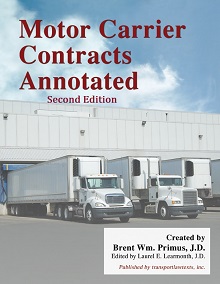
- Motor Carrier Contracts Annotated, Second Edition is a contract form book with four complete contract templates designed for easy use by shippers and their attorneys.
- The four contract templates include optional provisions with comments and instructions on how to use allowing the user to tailor the contracts for individual clients or situations.
Why spend valuable time and money to “reinvent the wheel”?

Shipper-Motor Carrier Contract Template
When a shipper uses a motor carrier, they should always have in place an individually negotiated contract to supersede the motor carrier's terms and conditions written by themselves. These terms and conditions usually have lower limits for liability for loss and damage to cargo, accessorial charges, late payment penalties, and other items a shipper would not knowingly agree to.
Shipper-Broker Contract Template
One of the most important things for a shipper to know when contracting with transportation brokers is that a broker is not a motor carrier. This means that you cannot simply take a shipper-motor carrier contract and do a global replacement of "motor carrier" with "broker"... yet this is exactly what many people do.
The shipper-broker contract template in the newly released Second Edition of Motor Carrier Contracts Annotated places several requirements on the broker to require specific things from the carriers that they use. This component of a shipper-broker contract would be completely missing if one simply replaces "carrier" with "broker" in a shipper-carrier contract.
Further, the shipper-broker contract template provides for the broker to assume liability for loss and damage to shipments. As a general proposition, brokers are not liable for damage to cargo, unless they assume liability by contracts such as the one in Motor Carrier Contracts Annotated. For a shipper this is the preferred way to go since they can then pursue their claims for loss and damage directly against the broker without having to chase the carrier.
NEW! Shipper-Provider Contract Template.
The 2011 edition of Motor Carrier Contracts Annotated contained just two contract templates. One was for a shipper to use with a motor carrier and one was for a shipper to use with a broker arranging for motor carrier transportation. There were just two templates because, generally speaking, that was how contracting was done at that point in time.
That all changed with the passing of the 2012 Highway Bill (Moving Ahead for Progress in the 21st Century Act or MAP-21) and an unanticipated consequence of its provisions.
As MAP-21 went into effect and the industry became aware of it, large, national transportation providers would add language into the shipper-carrier contract saying, “We reserve the right to use our brokerage authority for the shipments tendered to us pursuant to this contract.” While this would satisfy the legal obligation of the providers, simply adding this language to a shipper-carrier contract does not adequately address the many issues relating to using as a broker.
This all gave rise to a need for another contract template which would provide for one shipper to contract with one corporate entity who held licenses both as a motor carrier and as a broker. In Motor Carrier Contacts Annotated, Second Edition it is called a Shipper-Provider Contract Template.
NEW! Shipper-Provider Contract Including Intermodal Template.
When an intermodal service is offered by a regulated motor carrier, it can do so by issuing a through bill of lading from origin to destination. When this is done by regulated motor carriers, it is often referred to as “substituted service”.
In 1977 the Interstate Commerce Commission (ICC) used the authority granted to it by Congress to exempt intermodal services. This gave rise to a new type of provider known as Intermodal Marketing Companies or IMCs. However, it is important to note that companies that customers think of as being a motor carrier or truck broker will also offer these exempt or unregulated services without using their motor carrier or truck broker license to do so.
The template titled “Shipper-Provider Contract Including Intermodal for Transportation by Motor Carrier AND Brokerage of Motor Carrier Transportation” is drafted to cover these service variations.
|
Click here to view or download the Table of Contents
What do you receive?
- • 80+ pages of contract clauses and commentary furnished in an electronic format.
- • Purchasers of the text will be entitled to a complimentary 30 minute consultation with the Author.
Here is what Mike Regan , President of TranzAct Technologies, Inc., Logistics Management magazine featured blogger, and industry leader had to say about the first edition of Motor Carrier Contracts Annotated in this 2:00 Minute Warning - Click Here.
About the Author:
Brent Wm. Primus, J.D., represented the shipper in the pivotal case of The Bankruptcy Estate of United Shipping Company, Inc. v. General Mills, Inc., 34 F.3d, 1383 (8th Cir. 1994). This decision of the former Interstate Commerce Commission set the stage for modern motor carrier contracting in a deregulated environment. Since that time Brent has worked extensively with shippers to develop and negotiate their contracts with various categories of transportation service providers.

About the Editor:
Laurel E. Learmonth, J.D., is a shareholder in Primus Law Office, P.A. and a Senior Editor for transportlawtexts, inc. Laurel has represented both corporate and individual clients in a variety of business transactions and litigation matters in both state and federal court. This includes transportation matters such as pursuing and defending cargo claims and collecting or defending disputed freight charges.